of chaos after trebuchets
Well, it needed to be completed. The drum beat chucking machine known now as trebuchet. But what happened next, I could never have expected.
A lot has happened, in the past week! I finally, after a delay of over a year, finished an arduino project initially just a drum buddy using the VS1053b ogg/mp3 encoder and midi chip.
https://github.com/poetaster/trebuchet …. PCBs are on the way ….
It’s not that exciting, but it’s very useful since it produces rythms euclidian but with motion on the postion of the first beat (rotation). Since it’s three instruments at a time, it doesn’t get boring and swings nicely.
But that just freed me up to finally get to something I’ve been brooding about for ages. Chaos.
Medieval Chaos.
All the modulation of the MI voice patch (braids running on the MMM module) is coming from the circuit I describe below … in time……
Since Chua’s circuit, many people have made chaotic circuits. In the mathematical sense, I mean. I’ve always found them wanting. I have a triple sloths (originaly from nonlinear circuits) copy and was always underwhelmed. Of course, there is always the amazing Ian Fritz! https://ijfritz.byethost4.com/index.htm …
However, all of Ian’s designs have been copied a dozen times. They are really neat, but will never be mine. After re-reading ‘Simple Autonomous Chaotic Circuits’ (Jessica R. Piper, Student Member, IEEE, and J. C. Sprott) I stumbled on a variant ‘A simple chaotic circuit with a light-emitting diode’ (https://oam-rc.inoe.ro/articles/a-simple-chaotic-circuit-with-a-light-emitting-diode/fulltext) …. which is at the heart of ŻŁOB MODULAR Diode Chaos For laughs, I built it. Hmmm, not that impressed, just as I had not had that much fun with Sprott’s CLC design.
Not to say that the math is not interesting or that the circuits are not interesting. It’s just that they are difficult to tune and not very flexible if we exclude the Hyper chaos from Ian. That latter circuit is of some complexity :)
I started toying with the LED design swapping LEDs for all the capacitors to see what might happen. That was not as easy as advertised. They neglected some details of the design (which op amps; single supply, double?) and it turned out more difficult to realize than advertised. But it had some interesting qualities. All the terms for the devivatives (the values of resistors and capacitors) are the same. Symetry is appealing. Especially when it yeilds chaos!
Still, didn’t really convince me. I dunno why. I probably just didn’t build it correctly :) Then I did a random search on a hunch. That led to https://cpldcpu.com/2020/06/15/building-a-chaotic-oscillator/ … which was exactly what I was looking for! All same values, only LEDs, transistors and resistors! What’s not to love. And it just works! Now the led in place of a diode approach of the ‘A simple chaotic ….’ paper uses op-amps and not transistors, and is dependant on capacitors using the led only as a source of uncertainty. ‘Tim’s experiment uses LEDs only. This got me from brooding to hacking!
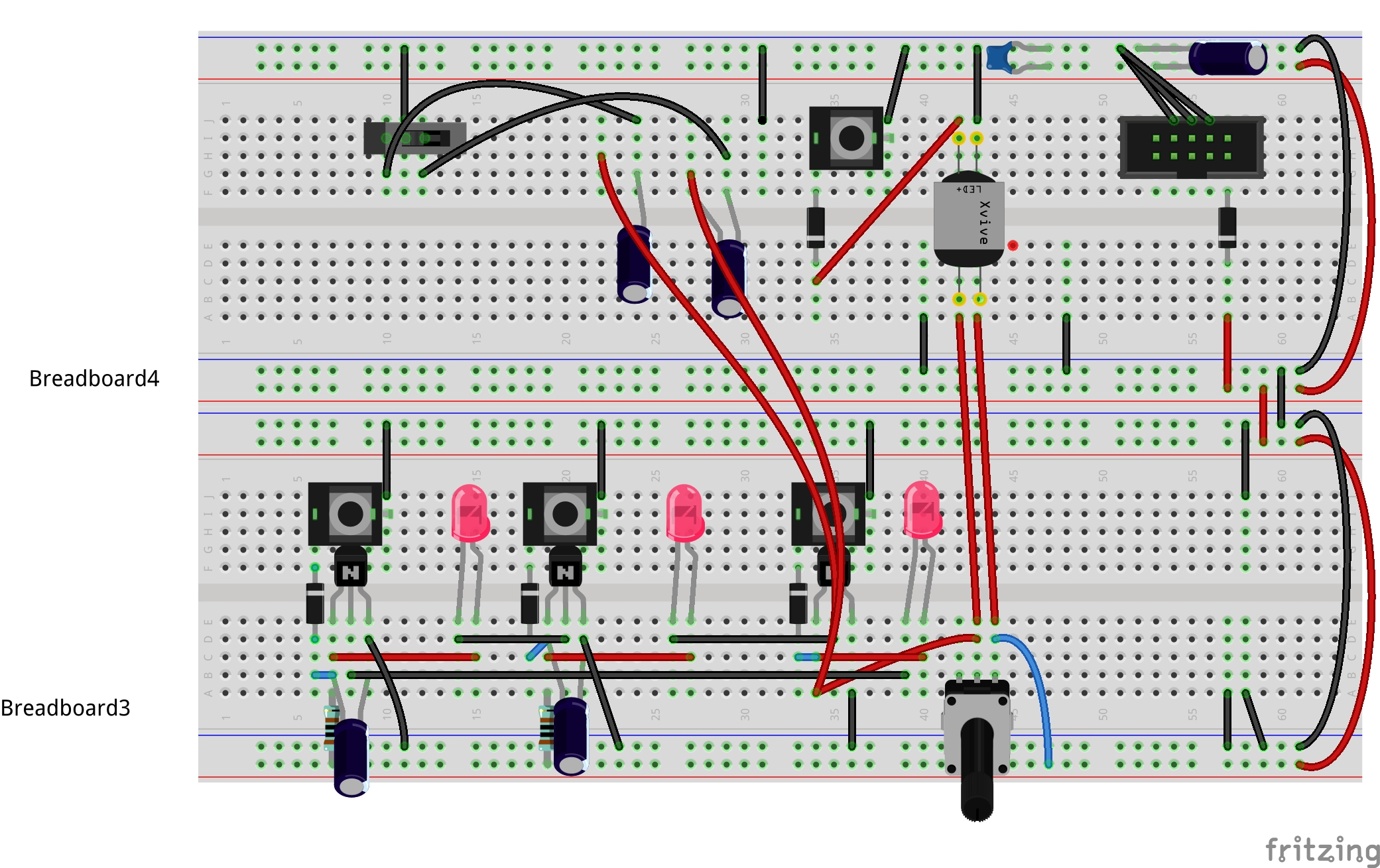
Here, a quick bread board sketch …
a scale monster
My design uses his insight that using leds (in my case RGBs that rotate) will give you oscillation with the minimal (300-400farrads) capacitance. AND it yeilds true chaotic behaviour (in the mathematicl sense). To make the idea useful for audio (tim’s proto produces very fast output), I placed 1000uF caps from emmiter to collector of each transistor and dropped the frequency to under 10hZ … so far so good. Then I adjusted the resistance to VCC until I had stable values and one variable pot that gave me a range of interesting behaviour. Even better!
The result, well, two well defined chaotic zones, some cross over waveforms and some wonky lfos! It’s great. Even better, you can feed cv in on the emitter of any transistor to get further odd behaviour.
Oh, and it has pretty lights. Blink, blink. Simple, flexible, looks good hanging on a wall. I’ll call it candelabra.
Now, to make a eurorack module … off I go ….
Obligatory links to my store sites.
and tindie