quick start
A short introduction to using the marvelous.
marvelousMI
Connections
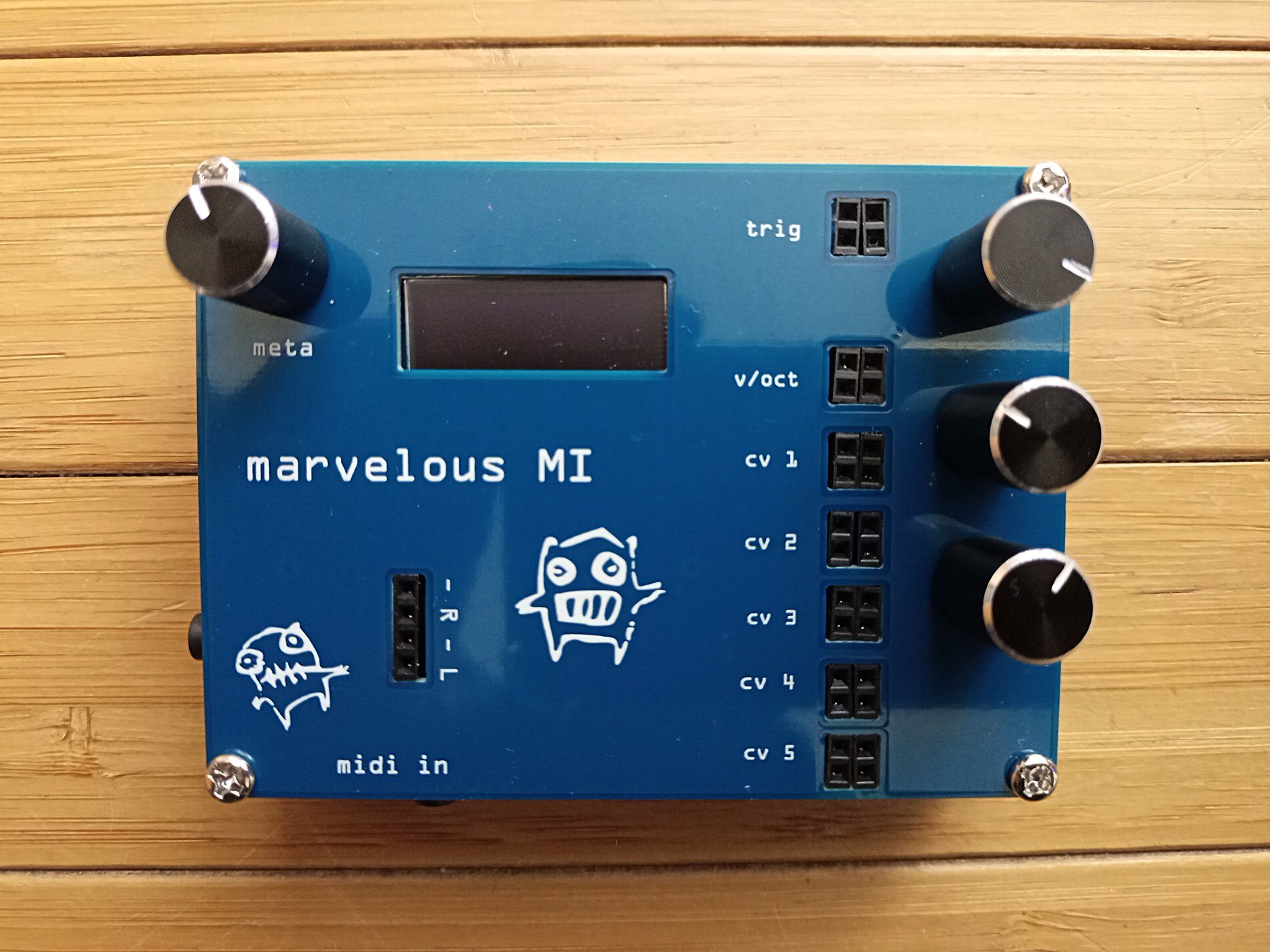
marvelous has two types of connections, 3.5 mm jacks and jumper pin headers. The 3.5 mm sockets are:
- stereo audio out on the left (headphone friendly)
- midi input on the front, Arturia ‘b’ type as opposed to korg ‘a’ type.
The meta knob
The meta button/encoder knob, upper left, currently has the following functions:
- Press down to advance through the modules: Plaits, Rings, Braids
- Turn the encoder to advance through the engines of each module
A/B/C encoders
The 3 encoders on the right directly control the main parameters of each module/engine.
- A corresponds to the ‘morph’(M), parameter of Plaits, damping (D), of Rings and color (C), in Braids It is labeled M, D or C in the display.
- B corresponds to the ‘harmonics’ (H) param of Plaits, the ‘structure’ (S) of rings and has no function in braids (atm). It is labeled H or S in the display.
- C corresponds to the ’timbre’ (T) param of Plaits, the ‘brightness’ (B) of rings and the timbre of braids. It is labeled T or B in the display.
In meta mode:
- Meta controls the Attack rate
- A controls the decay rate
- B controls the sustain volume
- C controls the release rate
The encoder buttons of A/B/C have various functions.
- A,
- short click the button to toggle A between global volume or the voice parameters
- holding the button for about one half second causes rings to go into easter egg (FM synth mode)
- B, pressing the button toggles ADSR update mode. The four encoders update the ADSR envelope settings and those are displayed.
- C, the button toggles encoder C between setting the timbre or the Position parameter.
Pin headers
The headers are designed for input voltages up to 3.3 volts and will clip any higher voltages. In order, top to bottom:
- trig is the trigger input. With a sufficient voltages (1 volt) it will cause a ’note on’
- v/oct will map an incoming voltage from 0-3.3 to the midi range 36-84 by default
- CV1 - corresponds to the morph parameter, encoder A
- CV2 - corresponds to the harmonics param, encoder B
- CV3 - corresponds to the timbre param, encoder C
- CV4 - controls the position paramter
- CV5 - is input for the exciter in Rings
The use of CV is still in progress.
Midi CC mappings
- CC 82 - position
- CC 74 - morph, damping, color
- CC 71 - timbre, brightness, timbre
- CC 76 - harmonics, structure
- CC 77 - position
- CC 17 - global volume