noodle
Noodle is a chaotic sequencer. I is an 8hp wide, 6hp deep analog eurorack module which can generate ‘wandering’ chaotic melodies. It can also make straight sequences of up to 8 notes, but that’s not the point :)
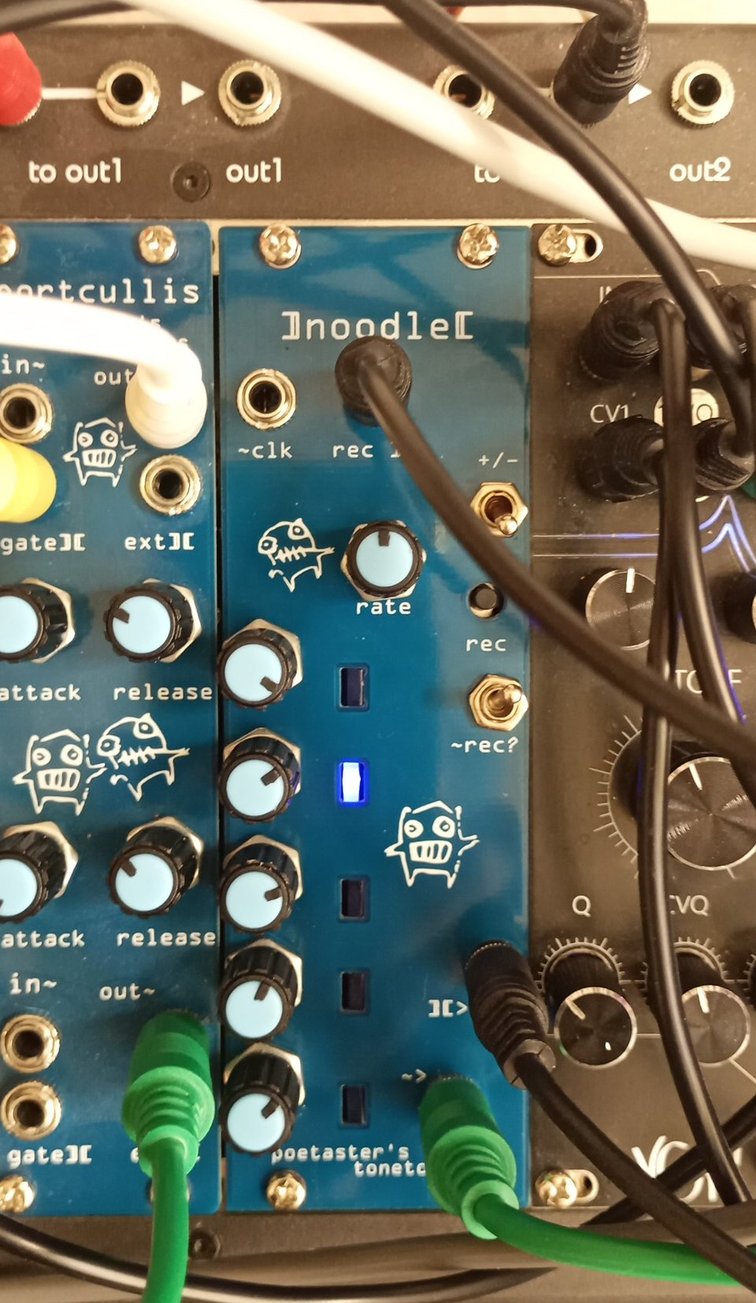
ina rack
The sequencer has 8 states, advanced by either the internal rate knob or an incoming ‘clk’ signal. But we don’t use all those like a normal sequencer :) We only use 3, which are enough to program what outputs are on on the other part of the device which has 1 input and 8 outputs :)
While noodle is running, you can change the state of any step with the rec button, the +/- switch above determing whether you turn it on or off. This will be non-linear :)
The module was made to have a ’tonality’ dialed in and them make intervals by an out of sync recording signal. Or just semi-random button punching. So, to noodle along when you DON’T want to make an explicit melody. Noodle is NOT a goode sequencer for making songs. It’s good at making many different patterns / melodies and at odd tempos. I use it while soldering in the lab.
This audio file is noodle and drum machine on a common clock. Noodle’s sequence record is being controlled by triggers from the drum module.
The 5 knobs on the left determine which pitches (voltages from 0-7) are output. 3 of the pots do double duty. And all the pots interact. That is to say, you dial in releationships more than a direct pitch. This produces more notes from 5 pots, but means it’s also, well, non-linear :)
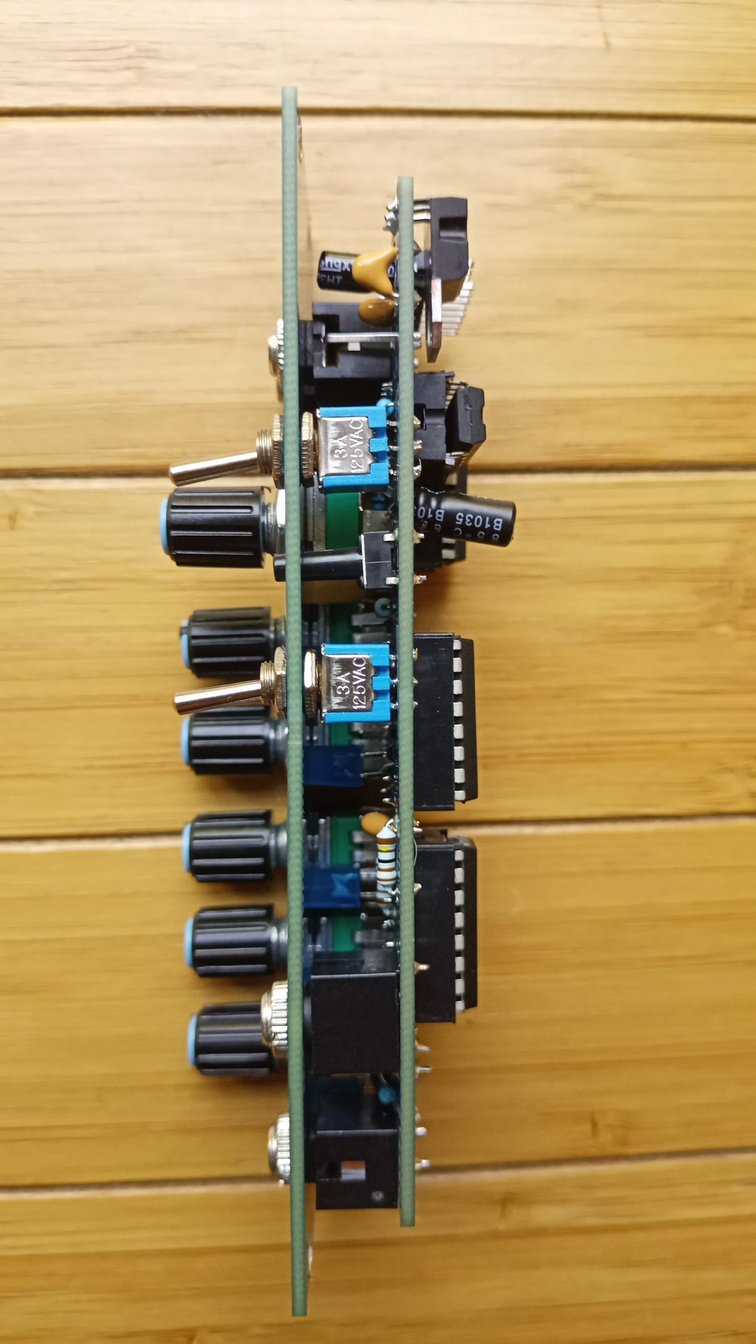
from the side
The real strength of the module is taking the rec gate input to switch the steps on and off. If the gate input is NOT in sync with the clock, you will get wandering melodies, selections of tuned inputs (1-5) and also an absence (0v). I use this, often, with the bass drum accent trigger of a drum module acting as ‘clk’ and then taking another accent (like snare :) to try the recording. Drum synced noodling.
This audio example is with noodle’s clock and record signal both coming from the MI grids triggers, also driving the drum. The accents are used to drive noodle while the main trigger drives the drum module.
Finally, a gate output > jack allows you to control an ADSR, VCA … it will be a bit wonky and may cut out while a note is playing.
This example show variety in the effect of the gate output, depending on the VCA release time…
In this video, noodle is getting both clock and record signals from MI grids drum trigger module.
Technical details
The power supply is regulated to 8volts to get trigger inputs in range.
The sequencer is basically the shift register (CD4015) prgoramming a mux. we use 2 of the A bank and 1 of the B bank of registers (the 4015 has 8) to toggle the state of an 8 chanel mux (CD4051) which determines which outputs/notes are open. Those are tuned by the pots. A second CD4051 wired to the same 4015 outputs provides the light show.
One of the 4015 outputs is fed out via ][> jack to allow you to control an ADSR, VCA … that signal is limited to 0-5V.
The note signal ouput is limited to 0-7V. Power used is approx. 25mA.
Schematics and gerbers, below:
Use the source, luke
Open Sources includes fritzing files, schematics and the gerber files to produce boards (tested with jlcpcb).
I made this module because I hate traditional sequencerers. There are some really cool ones, but I can’t affort them. I always end up with more material than you need :) If you’d like to purchase one they can be had built for 78 euros. You can also purchase at etsy, https://tonetoys.etsy.com/ or on tindie https://www.tindie.com/stores/poetaster/